The companies powering AI have worked with us for years
Many were our clients in compute, semiconductors, and hardware long before AI led every headline. We have stayed close as they moved into this next phase, so we already know the operators who can lead it.
Technical depth and
commercial nerve.
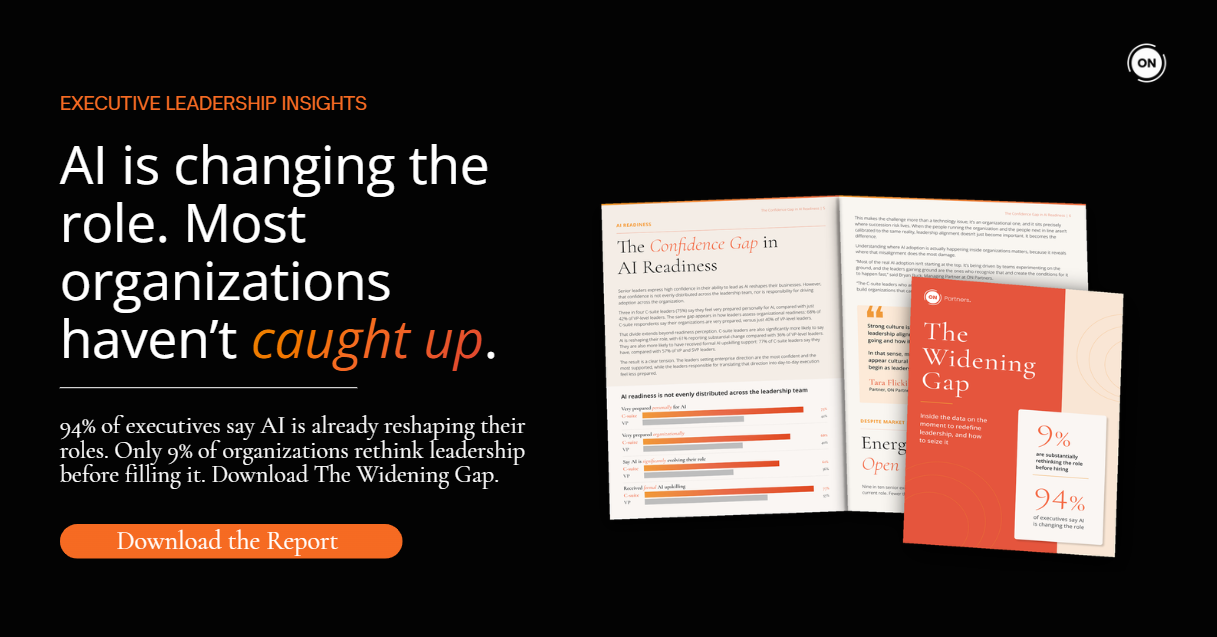
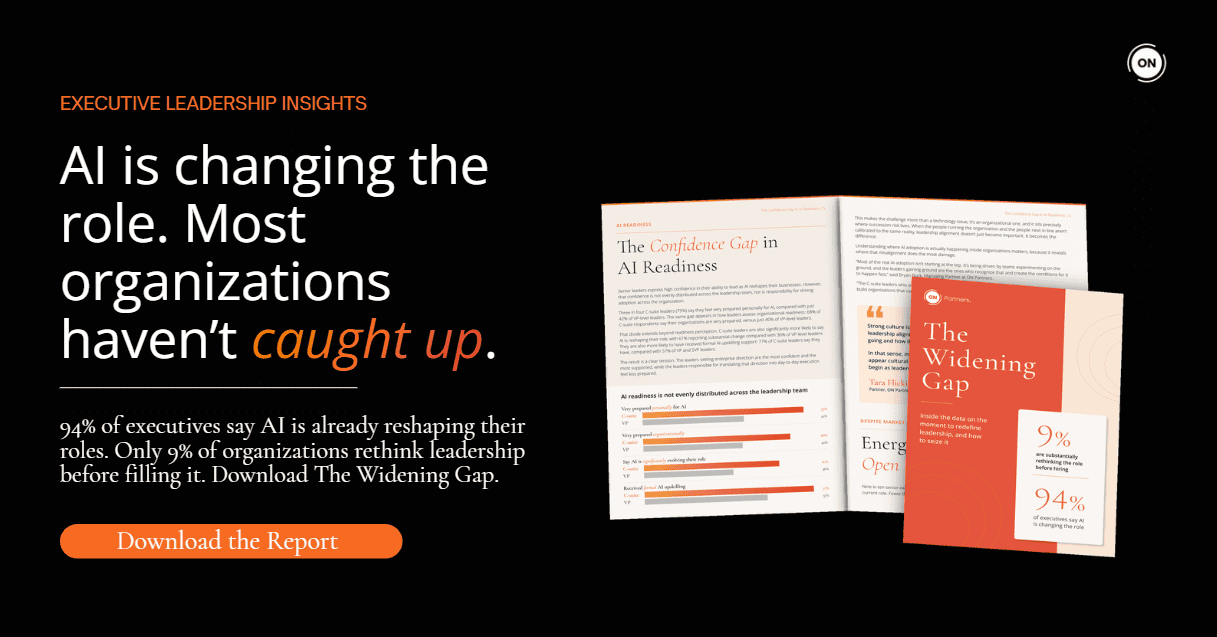
Technology leadership in 2026 demands real technical depth and commercial nerve in one person. Our research found 94% of executives say AI is reshaping the role, yet only 9% rethink that role before they hire for it. Boards that close the gap get a leader built for the job they have now. Reaching that leader takes a partner who already has the relationship.
Source: ON Partners Widening Gap, 2026
Driving meaningful change on a global scale.
Click to see who we've placed, what roles we run most, and what's driving demand right now.
We have grown with the companies powering AI
Many were our clients in compute, memory, and photonics before AI led every headline, and we stayed close as they moved into this phase. So when you need someone who can build the systems models run on, or turn those models into product, we already know who they are and how to reach them.
Most-placed roles in this industry

AI has raised the stakes on security
As AI makes attacks faster and harder to catch, a breach now puts data, customer PII, brand reputation, and regulatory standing on the line. We place the leaders building the teams that protect all of it, across detection, identity, and data protection.
Most-placed roles in this industry
Data became a revenue question
What was once governance and reporting is now where companies expect growth, and AI has raised what the data has to deliver. We know the operators who turn data into a business advantage, and our relationships across the market mean we can introduce you to the right one.
Most-placed roles in this industry
From the lab to volume deployment
Plenty of autonomous systems work in a demo. Far fewer reach real deployment and revenue, where hardware, software, and commercial execution all have to hold together. We know the leaders who have made that leap, because we have worked alongside them and the companies backing them.
Most-placed roles in this industry

Thousands of Searches
Software is one of our most active sectors, from B2B SaaS and cloud platforms to developer tools, much of it for PE-backed and venture-backed teams scaling past founder-led growth. After thousands of these searches, the operators who have done it before are already in our network.
Most-placed roles in this industry

AI put hardware back at the center
Semiconductors and hardware is where ON Partners started. Before AI made chips a household conversation, before reshoring became a national priority, we were running searches for the engineers, operators, and commercial leaders who built the industry. That history matters because we don't just know the space, we already know the people.
Most-placed roles in this industry
Meet the experts
A sample of the people who could run your search

What clients say after the search is closed
Entire team is fantastic.
Great process with strong communication. Candidates exceeded our expectations.
Bailey continuously presented great candidates and candidates were extremely positive on the engagement with her.
Found a good CFO in the end.
Companies trust ON Partners
Leaders recently placed
Successful Placement
DecisionHR Hires New Chief Revenue Officer
Josh McIntosh Appointed as Chief Revenue Officer at DecisionHR
Jun 12, 2026 11:51:25 AM
Successful Placement
Power Integrations Appoints New Senior Vice President, Worldwide Sales
Power Integrations Names Mike Balow Senior Vice President, Worldwide Sales
Jun 11, 2026 4:34:41 PM
Successful Placement
Safe Software Appoints New Chief Financial Officer
Safe Software bolsters leadership team with CFO appointment to drive next phase of growth
Jun 4, 2026 3:50:14 PM
Successful Placement
Ready Rebound Appoints New President and Chief Revenue Officer
Ready Rebound Names Jim Tarantino as President and Chief Revenue Officer
May 28, 2026 2:43:13 PM
Successful Placement
Wagepoint Names New Chief Commercial Officer
Wagepoint Appoints Alexander Gonçalves as Chief Commercial Officer to Accelerate Next Phase of …
May 28, 2026 1:42:08 PM
Successful Placement
Diebold Nixdorf Appoints New Chief Information Officer
Diebold Nixdorf Names Raj Singh as Chief Information Officer
May 18, 2026 4:16:46 PMReady to find your next AI leader?
A conversation is all it takes to know if we're the right fit. Tell us about the role, and we'll tell you what the market looks like. You'll speak directly with the partner who would lead your search.
Related Insights From ON Partners
Insight
2026 Leadership Report | AI & Succession Planning | ON Partners
94% of leaders see the AI shift; only 9% are hiring for it. Discover why the window to redefine…
Jun 15, 2026 11:51:48 AM
Insight
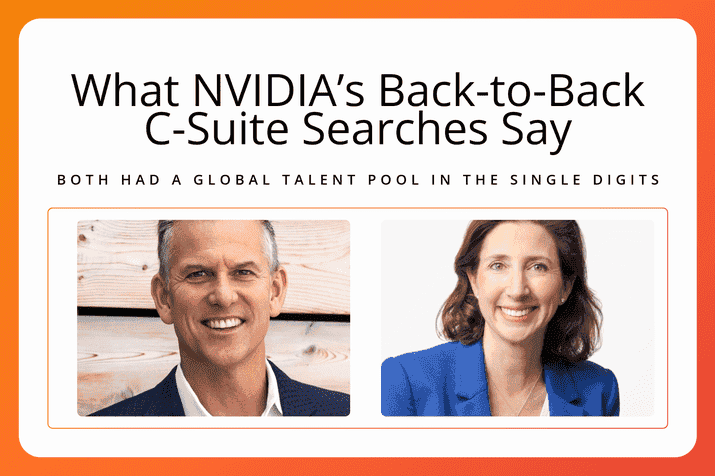
What NVIDIA’s Back-to-Back C-Suite Searches Should Tell You
NVIDIA’s back-to-back CMO and CAO placements share one defining characteristic: both had a glob…
Jun 9, 2026 10:03:25 AM
Insight
ON Partners Research Finds AI Is Changing Executive Roles Faster Than Organizations Are Rethinking Them
ON Partners surveyed senior leaders across industries and found a critical gap between how exec…
May 19, 2026 9:06:22 AM
Insight
Elevating Supply Chain from 'Necessary Evil' to C-Suite Influence
Supply chain management has undergone a dramatic shift — from a behind-the-scenes necessity to …
Apr 30, 2026 10:08:54 AM
Insight
How Pay Parity Is Reshaping Women’s Leadership and Executive Search
ON Partners' data from 1,000+ senior-level searches shows measurable progress in executive pay …
Apr 29, 2026 1:41:37 PM
Insight
AI Adoption Isn’t a Technology Problem – It’s a Leadership One
AI adoption is accelerating, but scaling it is a leadership challenge. Explore how executives a…
Apr 28, 2026 11:55:15 AMWhat your peers are dealing with in
AI & emerging tech
The executive leadership challenges in this industry are moving faster than most anticipated. Here's what's actually driving search activity right now and what it means for the leaders companies need.
Talent exists. Closing them is the problem.
The executives who have shipped production AI at scale, sold enterprise automation into Fortune 500 accounts, or built a semiconductor commercial organization from scratch are identifiable. They're just not looking, and they're already getting 10–15 approaches a month.
- 75% of executives say market uncertainty is actively slowing leadership movement
- Chief AI Officer role has no established talent pipeline
- The best candidates receive 10–15 approaches monthly
- Off-limits conflicts at large firms shrink your candidate pool
- Long processes lose candidates to faster competitors
The companies that move first are building durable advantages.
AI is not a feature. It's becoming a platform for how companies compete. The organizations hiring the right leaders now are compressing the time it takes to build real AI capabilities. That head start is worth 12–24 months of competitive lead time.
- AI-native companies can attract operators from Big Tech
- PE-backed companies can move faster and offer equity upside that public companies and hyperscalers cannot match
- The first CMO or CDO can define an entirely new category
- 40% of C-suite leaders say AI fluency is the #1 leadership capability needed in the next 3–5 years. Those companies hiring for it now are 12–24 months ahead
The definition of a "good tech executive" is being rewritten.
The CTO hired in 2019 may not be the right leader for 2026 and the CISO hired before AI-driven threats emerged is already behind. Role expectations are shifting faster than careers can keep up and the gap between who is in the seat and what the seat now requires is widening every quarter.
- 57% of organizations have no ready successor for critical leadership roles, according to our Leadership Clock Report
- CTOs must now have a credible AI strategy, not just roadmaps
- AI has expanded the attack surface faster. Model poisoning and deepfake-driven social engineering are now board-level threats.
- CDOs are being asked to generate revenue, not just manage data
What leaders may ask before a search
- The Builder: has shipped production AI systems at scale. Comfortable at the infrastructure and model layer. Ideal for companies building AI capability from scratch.
- The Strategist: translates AI potential into business initiatives and board-level roadmaps. Ideal for enterprises in early transformation.
- The Commercializer: takes an existing AI product and drives revenue from it. Ideal for companies with working technology that hasn't found its GTM motion.
- AI CTOs need ML credibility in addition to engineering leadership
- Candidate pool is meaningfully smaller than for SaaS CTOs
- Compensation benchmarks differ significantly
- Role expectations from investors vary by stage and sector
- You are processing data that creates regulatory exposure — HIPAA, SOC 2, GDPR at scale
- A breach would materially harm revenue, customer relationships, or fundraising ability
- Your board has added a risk or audit committee or is preparing to
- You are entering enterprise sales and prospects are asking about security posture
- You are post-acquisition and the acquiring PE firm requires a security function
- SEC rules now require public companies to disclose material cybersecurity incidents within four business days — executives who don't own that definition are a governance liability
- "How many CAIO or AI leadership searches have you completed in the last 24 months?" A firm with genuine depth can give you a specific number and describe the searches. A firm without it will give you a category answer ("we've worked across technology broadly").
- "Who are the off-limits candidates in AI, and how does that constrain this search?" Every firm has off-limits. The size of that list in AI tells you how committed they are to this sector — and how constrained your candidate pool will be.
- "Who on your team will run this search, and what is their direct experience in AI?" A large firm will often have sector expertise in the practice but assign the search to a consultant who is newer to the vertical. At a partner-led firm, the person you meet is the person who works your search.
- Chief Data Officer: AI runs on data. Without this function in place, AI projects stall at the data readiness problem — which is almost always the real blocker. Hire this before the CAIO.
- Chief AI Officer or VP of AI: Sets strategy, creates governance, and keeps the company from burning budget on initiatives without a business case. Hire after data infrastructure exists.
- Chief Product Officer: AI that doesn't get built into the product doesn't scale. The CPO determines whether AI stays a demo or becomes a moat.
- Chief Revenue Officer: Selling AI-powered products requires a different motion — buyers have high interest and high skepticism simultaneously. A CRO who has navigated category education cycles is worth disproportionately more.
- CISO: AI dramatically expands the attack surface. Companies that don't hire this ahead of scale are building liability, not capability.
- The attack surface expanded overnight. AI has introduced entirely new threat vectors — model poisoning, adversarial inputs, deepfake-driven social engineering, and automated phishing at a scale no human team can manually defend against. A CISO hired before 2023 may have had no material exposure to any of these.
- Personal liability is now real. The SEC requires public companies to disclose material cybersecurity incidents within four business days. "Material" is not always well-defined — and the CISO who cannot make that call confidently is a governance gap waiting to become a headline.
- Regulatory complexity is compounding. GDPR, DORA, SEC disclosure rules, HIPAA, and sector-specific frameworks are tightening simultaneously across jurisdictions. A CISO who can navigate one framework but not all is a single-point-of-failure risk for any company with cross-border operations.
- The role now requires board fluency. The CISO who cannot present risk in business terms to a board — without technical jargon — is not equipped for the role as it now exists. Communication and governance capability is as important as technical depth.